


Your Basket is Empty!




Tyre Sizes Explained – A Complete Guide to Understanding Tyre Dimensions
Understanding Tyre Sizes
Every tyre fitted to a vehicle has a specific size and specification designed to match the vehicle manufacturer's requirements. Tyre size affects everything from handling and braking performance to fuel efficiency, ride comfort, load-carrying capacity, and speed capability. Understanding tyre sizes is essential when replacing tyres, upgrading wheels, or ensuring your vehicle remains safe and compliant with manufacturer recommendations.
Although tyre markings may appear complicated at first glance, they provide valuable technical information about the tyre's dimensions, construction, performance capabilities, and suitability for a particular vehicle.
Where Can You Find Your Tyre Size?
Tyre size information is usually displayed in several locations:
- On the tyre sidewall
- Inside the driver's door frame
- Inside the fuel filler flap
- In the vehicle owner's manual
- On manufacturer information stickers
The sidewall contains the most detailed information and is the primary reference when purchasing replacement tyres.
Understanding a Typical Tyre Size
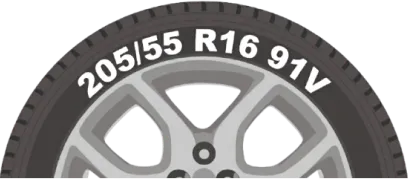
A common tyre size may look like this:
225/45 R17 94W
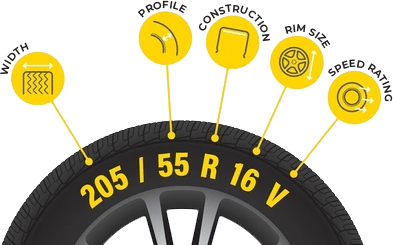
Each section of this code provides specific technical information.
225 – Tyre Width
The first number represents the tyre's width in millimetres.
In this example:
225 = 225mm wide
This measurement refers to the distance between the outer and inner sidewalls when the tyre is correctly mounted and inflated.
Generally:
- Wider tyres provide increased road contact.
- Improved grip and handling.
- Enhanced cornering performance.
However, wider tyres may also increase rolling resistance and affect fuel economy.
45 – Aspect Ratio
The second number is known as the aspect ratio or profile.
In this example:
45 = Sidewall height is 45% of tyre width
For a 225mm tyre:
225 × 45% = approximately 101mm sidewall height.
Lower profile tyres generally offer:
- Improved steering response
- Better cornering stability
- Sportier appearance
Higher profile tyres often provide:
- Increased ride comfort
- Better shock absorption
- Improved protection against pothole damage
R – Radial Construction
The letter indicates the tyre's construction type.
R = Radial Construction
Virtually all modern passenger vehicles use radial tyres because they provide:
- Improved durability
- Better fuel efficiency
- Enhanced ride comfort
- Longer tread life
Radial tyres feature internal cords running perpendicular to the direction of travel, creating a strong yet flexible structure.
17 – Wheel Diameter
The number following the construction code indicates the wheel diameter.
In this example:
17 = Fits a 17-inch wheel
This measurement must exactly match the wheel size fitted to the vehicle.
A tyre designed for a 17-inch wheel cannot safely fit a 16-inch or 18-inch wheel.
Understanding Load Index
After the tyre size, you will find the load index.
In our example:
94
The load index indicates the maximum weight a tyre can safely carry.
A load index of 94 corresponds to:
670kg per tyre
Since a vehicle has four tyres, the total load capacity would be significantly higher.
Manufacturers specify minimum load ratings to ensure safe operation under all driving conditions.
Fitting tyres with lower load ratings than recommended is not advised and may compromise safety.
Understanding Speed Ratings
The final letter represents the tyre's speed rating.
In our example:
W = Up to 168 mph (270 km/h)
Common speed ratings include:
- T – 118 mph
- H – 130 mph
- V – 149 mph
- W – 168 mph
- Y – 186 mph
The speed rating indicates the maximum speed the tyre is designed to sustain safely under controlled conditions.
Replacement tyres should meet or exceed the manufacturer's specified speed rating.
Why Correct Tyre Size Matters
Using the correct tyre size is essential for maintaining vehicle safety and performance.
Incorrect tyre sizes can affect:
Speedometer Accuracy
Changes in tyre diameter can cause speedometer readings to become inaccurate.
Handling Characteristics
Different tyre sizes may alter steering response, cornering behaviour, and overall vehicle stability.
Braking Performance
Tyre dimensions influence grip levels and stopping distances.
Fuel Efficiency
Wider tyres often create greater rolling resistance, which can increase fuel consumption.
ABS and Stability Control Systems
Modern safety systems rely on accurate wheel speed data. Incorrect tyre sizes can interfere with system performance.
Plus Sizing and Wheel Upgrades
Many vehicle owners choose to upgrade wheel sizes for aesthetic or performance reasons.
This often involves:
- Larger wheels
- Lower profile tyres
Known as "plus sizing," this approach maintains a similar overall tyre diameter while increasing wheel size.
For example:
- 205/55 R16
- 225/45 R17
Both combinations may have similar overall rolling diameters while offering different handling characteristics.
Professional advice should always be sought before changing tyre sizes.
Seasonal Tyre Sizes
Some manufacturers approve different tyre sizes depending on:
- Summer tyre fitment
- Winter tyre fitment
- All-season tyre applications
Winter tyre packages often use narrower tyres to improve snow traction and winter performance.
Always follow manufacturer recommendations when selecting seasonal tyre sizes.
Conclusion
Tyre size markings provide critical information about a tyre's dimensions, load capacity, speed capability, and construction. Understanding these markings helps motorists make informed decisions when replacing tyres and ensures their vehicle continues to perform safely and efficiently.
Choosing the correct tyre size not only maintains manufacturer safety standards but also protects vehicle handling, braking performance, fuel economy, and overall driving comfort.
Whether replacing a single tyre or fitting a complete set, understanding tyre sizes is an important part of responsible vehicle ownership.